





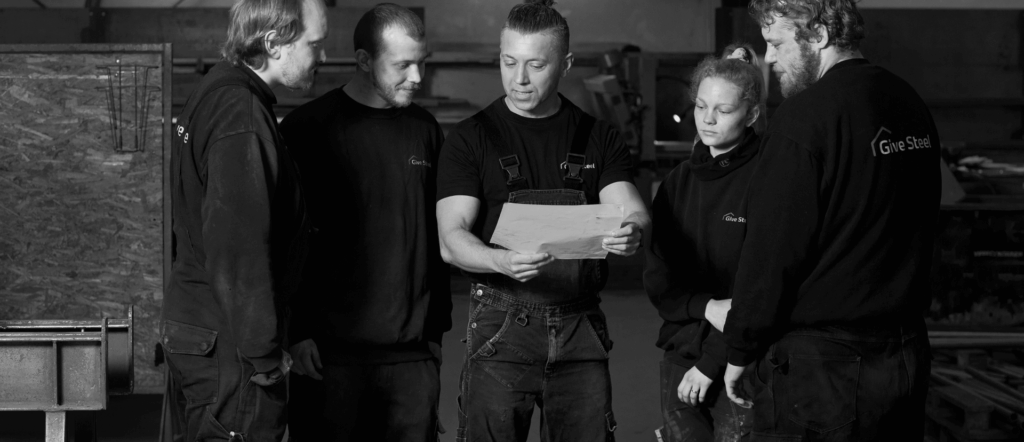
A day spent doing hands-on work alongside good colleagues gives everyone a sense of purpose at this property company, which employs people from the fringes of the labour market.
Plaster and filler residue hangs in the air at a Viborg home that is still in the process of being built. Its owner, Thomas Gjørtler Jensen, and several workers are in the process of renovating one of the buildings owned by Gjørtler Ejendomme. Apprentices and flex-jobbers are in full swing, building their own foundations when it comes to finding a greater sense of purpose.
Thomas’s company employs two apprentice joiners, an EGU apprentice, three flex jobbers and two people who had been put on early pensions, as well as another two employees on social security. Running alongside some diverse work placement schemes in close partnership with Viborg Municipality, this makes good sense for the company and its owner.
There’s a Danish song by a singer called Pauline that goes something along the lines of “Everybody wants to mean something to somebody.” I think that line is a great description of how important it is for people to be part of some kind of community. When I can help my workers to develop and experience that the work they do is worthwhile, it all makes perfect sense.”
As an on-the-job boss, Thomas does not feel that his everyday job is harder because he has recruited people from the fringes of society. In his own words, all he has to do is comport himself in a decent manner and make himself available. All it takes for the best possible results is for Thomas to understand the people and their situations, just has he would with any other employee. “These people have been part of the system for many, many years. So we are trying to give them something to hope for. It’s always more fun when people find success at the same time as having an actual job.”

Offered an early pension at age 18
One of the people who has a new sense of hope is Thomas Lauridsen, an apprentice on his third year at Gjørtler Ejendomme. He never graduated from school and was offered an early pension when he was just 18, which he refused five years ago. Thomas Lauridsen has atypical autism and struggled for a long time to find a company willing to offer him an internship or apprenticeship, so he could complete his vocational training. Everything changed when Gjørtler Ejendomme gave him an internship during the summer holidays, which later led to an apprenticeship. Thomas’s diagnosis means that he prefers his own company and his many previous failures led him to spend most of his waking hours playing computer games.
“I was lucky to end up here, as it’s a place where I can get help while being accepted just the way I am. If I hadn’t ended up at Gjørtler Ejendomme, I’d probably have ended up dropping out and going back to living my life on my computer.” During the summer internship, Thomas was a man who lacked self-confidence after several years with no real social contact. “I lacked structure in my life and a real purpose that made it worth getting out of bed for. Since starting my apprenticeship, I’ve become better at speaking Danish – which is my native language – for the simple reason that I now spend time with other people when I am at work. When I was computer gaming, I mostly spoke English” he explains.
Thomas now hopes for a future where he can combine his joinery skills with further training as a building constructor. His dream his to combine his interest in computers with a trade; to be able to geek out on technical plans that can become real buildings when he becomes a fully-qualified joiner in a year’s time.
Everyone has superpowers
Thomas Gjørtler Jensen used the Social Sustainability Calculator to see how his commitment and involvement lead to actual benefits when turned into figures. He thinks that this helps him to better tell positive stories from the daily routine and inspire others by helping them to see why CSR recruitments make very good sense.
“Everyone has their own superpowers. Diagnoses like autism or ADHD bring different abilities with them. And it is my job to make sure that they aren’t wasted.”
The company owner is well aware that the calculator should not just be a way of flexing or a way of squeezing people into jobs for the benefit of society and to suit the needs of companies. “These people must not be commodified. The calculator does not tell you how a person is really doing, and that must always come first,” emphasises Thomas Gjørtler Jensen. This is why he thinks that municipalities should be providing support to the business community in a way that makes it attractive to recruit apprentices from outside the mainstream, concluding
“Then it starts to make perfect sense for everybody involved.”
